
From the 30-share blue-chip pack, Adani Ports, UltraTech Cement, Larsen & Toubro, Sun Pharma, HDFC Bank, ICICI Bank, NTPC and State Bank of India were the major laggards. Tata Consultancy Services, Reliance Industries, ITC, Asian Paints, HCL Tech and Maruti were among the gainers.

As the results season kicks in, the quarterly earnings numbers of several blue-chip firms -- such as Infosys and Reliance Industries -- along with global trends and trading activity of foreign investors, will determine equity market movement in the holiday-shortened week ahead, according to analysts. The domestic WPI inflation data for June -- scheduled to be announced on Monday -- will also influence trading sentiments, traders said. Markets will remain closed on Wednesday for Muharram.

'We have not even used 0.1% of the available resources.'

India's economic growth rate decelerated to 6.2 per cent in the October-December quarter this fiscal, mainly due to poor performance by mining, manufacturing and all other sectors, with the exception of agriculture. However, on a sequential basis, the economic growth rate in the third quarter showed improvement over 5.6 per cent recorded in the second quarter.

Gross GST revenue rose 12.3 per cent to Rs 1.96 lakh crore in January on higher domestic economic activity, government data showed on Saturday. This includes 10.4 per cent growth in revenue from sale of goods and services domestically at Rs 1.47 lakh crore and 19.8 per cent rise in tax revenue from imported goods at Rs 48,382 crore.

Reliance Industries Ltd on Friday reported a 2.4 per cent rise in its March quarter net profit as store rationalisation in retail business and improved margins in telecom helped offset weakness in mainstay oil and petrochemicals business and higher finance cost. Consolidated net profit of Rs 19,407 crore, or Rs 14.34 per share, in January-March - the fourth quarter of April 2024 to March 2025 fiscal (FY25) - was higher than Rs 18,951 crore, or Rs 14 a share, in the same period a year back, the company said in a statement.

Farm workers and drivers will figure among the fastest growing jobs over the next five years, while roles of cashiers and ticket clerks will see the largest decline, a new study showed on Wednesday. In its Future of Jobs Report 2025, the World Economic Forum (WEF) also said that 170 million new jobs will be created by 2030, while 92 million are projected to be displaced, resulting in 78 million net new jobs.

The outcome of the Union Budget, quarterly earnings from corporates and global trends are the major factors to drive stock market sentiments this week, analysts said. Besides, the trading activity of foreign investors, the rupee-dollar trend and the movement of global oil benchmark Brent crude are also crucial aspects to watch out for.

Global funds have pulled out Rs 1.54 trillion from domestic stocks in fiscal 2024 - 25 (FY25), the highest-ever outflow recorded so far, according to the data compiled by Business Standard. The last time the global funds exited Indian shores in droves was back in 2022, when they sold a net Rs 1.41 in the backdrop of Covid-19.

Competition from Nepalese teas -- which has duty free access to the Indian market -- has emerged as a lower-cost alternative to Darjeeling tea, challenging its viability.

Global factors and FII activity will dictate trends in domestic equity markets this week while assembly poll results of Maharashtra and Jharkhand may impact stocks on Monday, say analysts. Stock markets witnessed a spirited recovery on Friday with benchmark Sensex and Nifty notching the best single-day gains in more than five months and offering relief after weeks of correction.

From the Sensex pack, Infosys, Tech Mahindra, Nestle India, Tata Consultancy Services, HCL Technologies, Asian Paints, Axis Bank, Zomato, Hindustan Unilever, and Bharti Airtel were among the laggards. On the other hand, IndusInd Bank, Tata Motors, Kotak Mahindra Bank, Bajaj Finance, HDFC Bank, ITC, Sun Pharma, Bajaj Finserv and UltraTech Cement were the gainers.
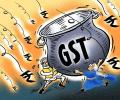
Gross GST collection in March grew 9.9 per cent to over Rs 1.96 lakh crore, government data showed on Tuesday.

Equity markets will take cues from the US tariff related developments, global trends and trading activity of foreign investors this week, analysts said.

As the poverty rates in the country declined below 5 percent in 2024, a research study by State Bank of India also highlighted that the extreme poverty in the country has been reduced to minimal.

The next government in these states may find it tough to push economic growth through long-term reforms, which would be necessary.

By democratising access to finance, empowering women and marginalised groups, and adapting to India's diverse regional landscapes, PMMY has helped fortify the country's grassroots growth engines, says Chief Economic Advisor to the Government of India, V Anantha Nageswaran.

The repo rate cut by 25 basis points by the monetary policy committee (MPC) of RBI announced Friday will give a long-awaited relief on interest rates and also be supportive of economic growth, according to experts. Repo rate is the interest rate at which the RBI lends money to commercial banks.

From FY20 to FY24, the revenue forgone due to tax incentives for individuals and Hindu undivided families stood at Rs 8.7 trillion, significantly higher than the Rs 4.53 trillion forgone for corporations.

Equity benchmark indices Sensex and Nifty rallied for the third session on the trot, helped by a rally in global markets after lower-than-expected consumer inflation in the US ignited hopes of more rate cuts by the Federal Reserve. The 30-share BSE index climbed 318.74 points or 0.42 per cent to revisit 77,000 level at 77,042.82.

India and the US are expected to have smooth trade negotiations after US President Donald Trump and Indian Prime Minister Narendra Modi had a productive meeting during Modi's visit to the White House last month, Stephen A Schwarzman, chairman, chief executive officer, and co-founder of one of the world's largest alternative investment firms, Blackstone Group, said in Mumbai on Wednesday.

The country's biggest carmaker, Maruti Suzuki India, has raised concerns about the continuing slide in small car sales.

The Supreme Court on Tuesday asked the Bihar government to put in the public domain the break-up of the caste survey data to enable those aggrieved to challenge the findings.

He added, "You can never trust Pakistan as long as the Pakistani deep state, Pakistani ISI, Pakistani military's objective is to destabilise Bharat."
Movement in the stock market this week will largely be driven by global trends, macroeconomic data announcements and trading activity of foreign investors, analysts said. Equity benchmark indices, which are on a dream run for the past several days, will also track trading in global oil benchmark Brent crude and movement of rupee against the US dollar. "The next FOMC (Federal Open Market Committee) meeting is scheduled for mid-September, but before that, the market will be closely watching upcoming US economic data.

Escalating trade tensions amid a tariff war after Donald Trump took over as President of the United States (US) could adversely impact global growth and fuel inflation, an article on the "State of the Economy" in the Reserve Bank of India (RBI) monthly bulletin said.

The weaker rupee will push the country's import bill due to higher payments for crude oil, coal, vegetable oil, gold, diamonds, electronics, machinery, plastics, and chemicals, economic think tank GTRI said on Friday. Citing an example, it said the depreciating domestic currency will increase India's gold import bill, especially as global gold prices have jumped 31.25 per cent, rising from $65,877 per kg in January 2024 to $86,464 per kg in January 2025.

Foreign investors have pulled out Rs 44,396 crore from Indian equities this month, driven by strength of the dollar, rising bond yields in the US, and expectations of a weak earnings season. This came following an investment of Rs 15,446 crore in the month of December, data with the depositories showed.

Caste census politics took centre stage on Thursday with the Congress terming the government's decision as a 'diversionary tactic' and a move for headlines management and the Bharatiya Janata Party saying it has exposed the difference between the Centre's 'true intentions' and the 'empty sloganeering' of the opposition party.

Taxing capital less may not lead to more investments but taxing more will drive capital away, Chief Economic Advisor V Anantha Nageswaran on Friday said during a discussion on Inequality, Economic Growth and Inclusion. While it is easy to drive capital out, bringing it back is a lot harder, said Nageswaran.

India needs another shot of difficult reform, of the kind only possible at gunpoint. Mr Trump holds that gun to our heads now. A drastic reduction in tariff protection, other elements of sarkari wet-nursing will force entrepreneurial India to become competitive again, argues Shekhar Gupta.

The exodus of FPIs from the Indian equity markets continued unabated, as they withdrew over Rs 7,300 crore (about $840 million) in the first week of this month due to global trade tensions, with the US imposing tariffs on countries such as Canada, Mexico, and China. This came following an outflow of Rs 78,027 crore in the entire January. Before that, they invested Rs 15,446 crore in December, data with the depositories showed.

'Pakistan is no longer a front-burner issue for America.'
Stock markets would take cues from the upcoming macroeconomic data announcements and global trends besides keeping a watch on the trading activity of foreign investors, analysts said. The last batch of the ongoing earnings calendar would trigger stock-specific action, traders said. "This week, we have to deal with macroeconomic data on both the domestic and global front.

After the post-pandemic slump in demand, unsold inventory in the affordable housing segment in the top seven cities dropped by 19 per cent in the first quarter of the 2025 calendar year (Q1CY25), according to a report by real estate consultancy firm Anarock.

Wholesale price inflation moderated to 2.31 per cent in January due to the decline in prices of food items especially vegetables, government data released on Friday showed. The Wholesale Price Index (WPI) based inflation was 2.37 per cent in December 2024. It was 0.33 per cent in January 2024.

'Indian players in the digital market should not be dominated by global players, and they should not dominate the smaller players -- these discussions are on.'

Growth in demand for diesel, India's most consumed petroleum product, fell to its lowest since the pandemic in the financial year ended March 31 as the economy expands at a slower pace and consumption shifts to cleaner fuels. Diesel consumption rose 2 per cent to 91.4 million tonnes in 2024-25 (April 2024 to March 2025) fiscal, according to provisional data released by the Petroleum Planning and Analysis Cell (PPAC) of the Oil Ministry.
Equity markets will take cues from global trends and trading activity of foreign investors, while in the latter part of the week the first quarter earnings from IT majors TCS and HCL Technologies would guide investor sentiments, analysts said. Markets may consolidate after the record rally last week, experts added. "On the domestic front, the Q1 earnings season begins this week. Key companies such as TCS and HCL Technologies will release their earnings on July 11 and 12, 2024, respectively.

eclined for the third month in a row in January, falling by 2.38 per cent year-on-year to $36.43 billion, while the trade deficit widened to $22.99 billion in the month. Imports rose by 10.28 per cent year-on-year to $59.42 billion in January due to an increase gold shipments, according to the Commerce Ministry data. The trade deficit was $21.94 billion in December and $16.55 billion in January last year.
